Doctoral dissertation on subsurface fatigue cracks examined at Tampere University
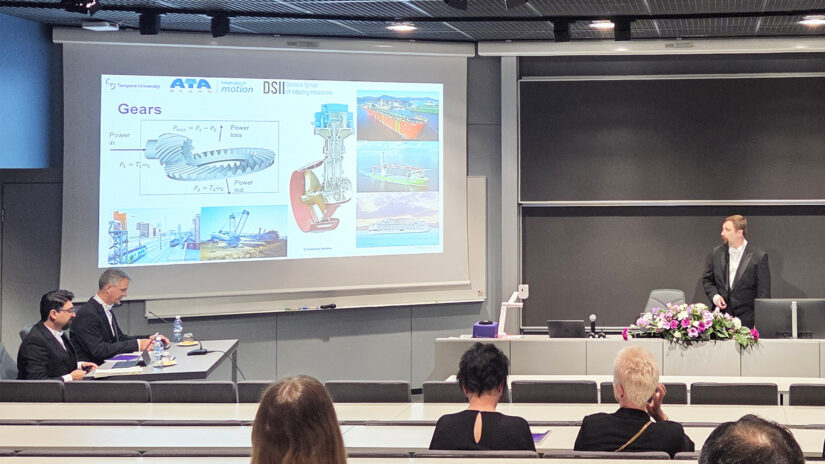
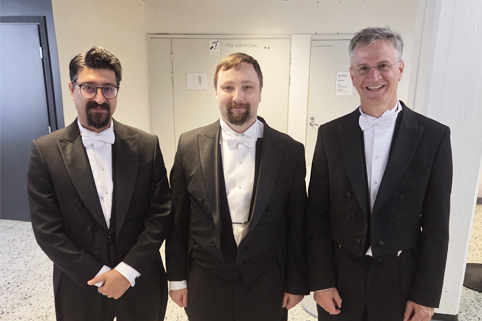
MSc (Tech) Erkka Virtanen successfully defended his doctoral dissertation entitled “Initiation and Growth of Subsurface Fatigue Cracks in Large-size Bevel Gears”, at the Faculty of Engineering and Natural Sciences, Tampere University on 26 June 2026. He thus became the second de facto academic ATA Gear Doctor. The public examination took place according to Finnish academic tradition at the Hervanta campus of Tampere University.
In his research, Virtanen investigated how subsurface fatigue cracks initiate and develop inside heavily loaded bevel gears. Through a combination of experimental studies and numerical simulations, he found that cracks can form beneath the gear surface without immediately causing failure. The research showed that such cracks generally propagate slowly, providing valuable information for assessing the remaining service life of gears.
The findings address a growing challenge in the maritime sector, where ultrasonic inspections have occasionally revealed hidden fatigue damage in large gears. In the absence of clear acceptance criteria, operators have often replaced gear sets as a precautionary measure. Virtanen’s work provides new insights that may help engineers evaluate gear condition more accurately, avoid unnecessary replacements, and improve both safety and cost-efficiency.
Large bevel gears are critical components in ship propulsion systems and heavy industrial equipment, where reliability is essential and replacement lead times can be lengthy. The research was conducted in collaboration between Tampere University, Kongsberg Marine AS and Ata Gears Ltd. The fatigue tests were conducted using the ATA Test Bench.
Professor Karsten Stahl of the Technical University of Munich, Germany and Professor Reza Talemi of KU Leuven, Belgium, acted as Opponents on the occasion of the public defence. The Custos of the public examination was Associate Professor Auezhan Amanov from Tampere University’s Faculty of Materials Science and Environmental Engineering.