
Innovative research: Optimization of tooth surface pressure distribution with an iterative computational algorithm
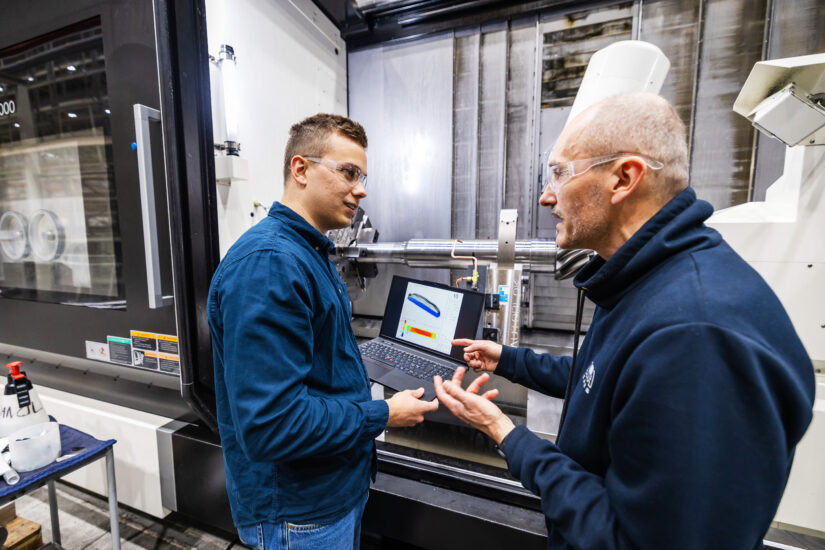
One recent outcome of ATA Gears’ continuous gear research is Iiro Sippola’s Master’s thesis, “Development and utilization of a tooth contact calculation tool in optimizing surface pressure distribution for the spiral bevel gears”. The thesis introduces an innovative iterative computational algorithm for the optimization of gear microgeometry and provides ATA’s design engineers with a powerful new tool for gear optimization.
“The self-improving method systematically removes material from such tooth flank areas where contact pressure is highest,” Iiro Sippola explains, and continues: “Based on a detailed mapping of the contact pressure distribution, targeted modifications are introduced to the tooth flank microgeometry. Material is removed most extensively in areas subjected to the highest contact pressures, thereby promoting a more uniform load distribution.”
Safe increase in power transmission capacity
When excessive contact pressure is detected near the tooth edges, the computational tool automatically initiates appropriate edge relief modifications. As a result, the contact pattern can be maintained within a safe central area of the tooth flank. Increasing the effective contact area of the loaded tooth flank reduces local stresses on both the tooth surface and the tooth root. Optimization of the contact pressure distribution consequently improves safety factors calculated according to established standards, including resistance to pitting, scuffing, and tooth root bending fatigue.
For ATA Gears’ customers, the method offers additional potential for increasing power transmission capacity. “It allows either more power to be transmitted through the same gear drive, or the same power output to be achieved with a smaller unit,” explains Iiro Sippola, who works as a Technical Sales Engineer at ATA alongside completing his studies. “Smaller may be more efficient in many ways; a smaller gear means reduced oil churning losses inside the gearbox. A more compact gearbox is also more cost-effective, but especially for underwater marine gearboxes the reduced hydrodynamic drag may be the most important aspect,” adds Gabor Szanti, Product and Process Development Manager at ATA and mentor of the master’s thesis.
5-axis technology in a key role
The iterative calculation algorithm is largely built around the capabilities enabled by 5-axis machining, in which ATA Gears is a pioneer in its industry. “As the iterative algorithm searches for improvements tirelessly, it modifies the tooth geometry in increasingly small locations,” explains Gabor Szanti. He continues: “Using our 5-axis milling technology we can precisely realize such tiny local geometric modifications that would be very difficult or impossible using conventional tooth generating machines.”
First application on the ATA Test Bench
The method was first applied for further optimizing the test gears undergoing fatigue testing on ATA Gears’ test bench. “The new calculation tool will be soon available also for customer projects. We are now working on some refinements and user interface for the new calculation tool, so that it does not only help us achieving better tooth contact but also helps us to speed up our design process,” says Gabor Szanti.